
TheStack · Training Aids Review
TheStack System Swing Speed Trainer Review
One stick, 30 weights, and an adaptive app program for serious speed training
Excellent
Tour Issue Score 9.0 · Ranked #5 of 18 in Training Aids
Best for: Committed, data-driven golfers who will follow an app-guided speed program two to three times per week with a radar
The Bottom Line
One stick, 30 weights, and an adaptive app program for serious speed training. The TheStack System Swing Speed Trainer scores 9.0 out of 10 in our research-based review, a excellent mark that puts it at #5 of 18 Training Aids in our rankings. Its strongest fit: Committed, data-driven golfers who will follow an app-guided speed program two to three times per week with a radar.
Full Review
The Short Version
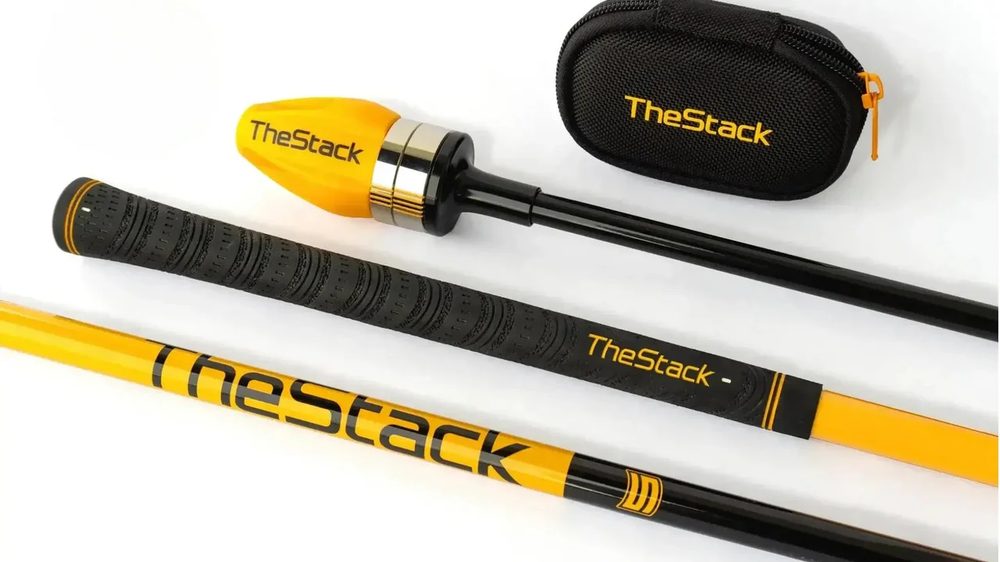
TheStack System is the premium, data-driven approach to speed training: one precision trainer, five screw-on weights that combine into 30 configurations, and an app that builds and adapts workouts from your measured swing speeds. It costs $299 for the trainer, with the first year of the app included in current bundles, and it expects you to train with a speed radar or compatible launch monitor. That structure is the whole point. Where simpler systems give you three fixed sticks and a protocol sheet, TheStack gives you a program that responds to what you actually did in the last session.
Performance
TheStack was designed with biomechanist Dr. Sasho MacKenzie, and its central performance idea is that optimal speed training needs variable loading, not just three fixed weights. The five weights combine to cover a spectrum from well under driver weight for overspeed work to well over it for overload strength work, and the app selects combinations, sets, reps, and rest based on a baseline test and ongoing results. Independent long-term reviews are unusually consistent: dedicated users report measurable clubhead speed gains over six to eleven weeks of regular training, with several reviewers documenting gains in the range of three to five miles per hour and corresponding distance increases, while emphasizing that results track adherence closely. TheStack itself cites a large user base and tens of millions of recorded swings behind its programming. Treat any single headline gain as individual, not promised, but the underlying method, progressive variable-load training with measured feedback, is the most sophisticated currently sold to amateurs.
Forgiveness
A speed trainer is forgiving if it meets different golfers where they are, and TheStack's adjustability helps here. Thirty weight combinations and app scaling mean a senior golfer, a junior graduate, and a 110 mph player are not all swinging the same fixed heavy stick. The app's guided structure also forgives uncertainty: you do not need to design a program, count complicated progressions, or guess when to move up, because the workout is prescribed and logged for you. The limits are physical and behavioral. Sessions are max-effort swinging, so golfers returning from injury or with back and shoulder issues should clear speed training with a professional first, and the system cannot forgive missed weeks. Reviewers who trained sporadically generally report sporadic results, while those who completed two to three sessions per week report the gains the marketing implies.
Feel and Sound
The trainer is about 42 inches long, slightly shorter than a typical driver, with a stiff-feeling shaft and a corded grip, and it is built to be swung, never to strike a ball. With no weights or light combinations it feels fast and whippy in the way an overspeed implement should; with heavy combinations it feels demanding and slow, which is the overload stimulus working as intended. The screw-on weight system and included carrying case feel precise and durable in published reviews, a step above basic molded training sticks. There is an audible whoosh at high speed that provides useful release feedback, though TheStack does not rely on sound as a training cue the way some rival single-stick trainers do. The app experience, timers, voice data entry on supported setups, and automatic logging where a compatible radar is connected, makes the session feel like a workout system rather than a gadget.
Value
Value requires the full math. The trainer is $299. A Stack Radar adds significant cost, with bundles commonly around $499, unless you already own a compatible radar or launch monitor such as a Garmin, FlightScope, or Rapsodo unit supported by the app. After the included first year, app membership renews at a further annual cost, with recent reviewer pricing citing roughly $99 per year for a Speed tier and $129 per year for Premium. That makes TheStack the most expensive mainstream speed trainer by a wide margin over SuperSpeed's classic set. Its value case is not cheapness, it is efficiency and adherence: individualized programming, measured progress, wedge and putting modules, and a learning library of more than 60 videos curated around the training. For a golfer who will train all winter, that cost per session becomes reasonable. For a golfer buying on impulse, it is an expensive stick in a case.
Who Should Buy It
Buy TheStack if you are a serious improver, you already own or will buy a radar, you like training to numbers, and you will protect roughly an hour a week for two to three sessions. It suits competitive amateurs, juniors with supervision and a long development runway, and older golfers specifically trying to reverse age-related speed loss through a structured program. Skip it if your swing fundamentals are still the main distance limiter, if you dislike app subscriptions, if you are on Android and need to confirm current app and launch-monitor sync features before buying, or if a simpler and cheaper fixed-stick system is all your commitment level honestly supports.
Verdict
TheStack System is the best speed trainer for golfers who will actually train like it matters: the most flexible hardware, the smartest programming, and the strongest evidence of gains among committed users in independent long-term reviews. It is also the most expensive and the least forgiving of inconsistency. Buy it as a program, not as a product, and it earns its premium. This is a research-based review synthesized from published reviews, independent test data, and manufacturer specifications; no personal testing was conducted.
What We Like
- Single 42-inch trainer with five precision weights creating 30 combinations from light overspeed to heavy overload training
- App programming adapts workouts to measured performance, co-designed around Dr. Sasho MacKenzie's speed-training research
- Only major system built to combine both overload and overspeed work in one stick, rather than a fixed set of separate sticks
- Guided sessions, progress tracking, and hands-free voice entry keep training structured and measurable
- Bonus wedge and putting programs plus a library of instructional content extend it beyond driver speed alone
What to Consider
- Premium all-in cost: $299 for the trainer, and a compatible radar or launch monitor is effectively required to follow the app program as designed
- App membership costs extra after the included first year, with reviewers citing about $99/year for Speed and $129/year for Premium tiers
- Gains demand max-effort sessions two to three times per week; inconsistent use produces inconsistent results
- Android app and third-party launch monitor integration have lagged iOS, with auto-sync for some devices reported as iOS-only
Specifications
| Trainer | Single approx. 42-inch trainer, stiff-feel shaft, corded grip; not for hitting balls |
|---|---|
| Weights | 5 precision screw-on weights creating 30 combinations for overspeed and overload training; carrying case included |
| App | Adaptive speed workouts with baseline testing and progress tracking; wedge and putting programs; iOS and Android (check current sync features) |
| Radar Requirement | Speed radar or compatible launch monitor required for app training as designed; Stack Radar available separately or in bundles |
| Price Note | $299 trainer; radar bundles approx. $499; app 1st year included in current offers, then annual membership applies |
Score Breakdown
Scores are research-based, drawn from manufacturer specs, tour adoption, and published independent test data. How we score
More Training Aids Reviews
All Training Aids →
Callaway
Callaway Alignment Stix
PuttOut
PuttOut Pressure Putt Trainer
Divot Board
Divot Board Swing Training Aid
Orange Whip
Orange Whip Full Size Swing Trainer
Lag Shot
Lag Shot 7 Iron Swing Trainer
DJI
DJI Osmo Pocket 3 Vlogging Camera

EyeLine Golf
EyeLine Golf Putting Alignment Mirror
PRGR