
HackMotion · Training Aids Review
HackMotion Wrist Sensor Review
Lead-wrist data and live feedback to fix clubface control
Very Good
Tour Issue Score 8.5 · Ranked #13 of 18 in Training Aids
Best for: Serious practicers and coached golfers fighting clubface-control faults such as casting, flipping, or a cupped lead wrist
The Bottom Line
Lead-wrist data and live feedback to fix clubface control. The HackMotion Wrist Sensor scores 8.5 out of 10 in our research-based review, a very good mark that puts it at #13 of 18 Training Aids in our rankings. Its strongest fit: Serious practicers and coached golfers fighting clubface-control faults such as casting, flipping, or a cupped lead wrist.
Full Review
The Short Version
HackMotion is a lead-wrist sensor system that measures the angles controlling your clubface, then coaches you out of bad ones with live audio and haptic feedback and guided drills. The current Sensor 4 hardware captures wrist motion at 800 frames per second using two six-axis motion sensors, pairs over Bluetooth 6.0, and sells in three software tiers on the same hardware: Core at $345 for the full swing, Plus at $490 adding putting, and Pro at $985 adding tour player comparisons, advanced wrist metrics, and multiple profiles. There is no subscription on any tier. Golf Monthly and multiple independent reviewers treat it as the leading dedicated wrist trainer, while also warning that it rewards golfers willing to learn what the numbers mean.
Performance
HackMotion tracks flexion and extension, bowing and cupping, plus radial and ulnar deviation and rotation, reported at address, the top of the backswing, and impact, with a real-time 3D hand model in the app. Published coaching sources note the clubface accounts for most of the ball's starting direction, and the lead wrist sets the face. After a short calibration and a handful of assessment swings, the app identifies a priority fault such as casting or an excessively cupped wrist at the top, ranks issues by urgency, and assigns drills with target ranges rather than a single ideal number, because correct angles depend on grip and swing pattern. Reviewers credit the instant biofeedback, a tone or, on Sensor 4, a linear haptic buzz the moment the wrist leaves its range, with making practice reps measurably different from unguided range time.
Ease of Use
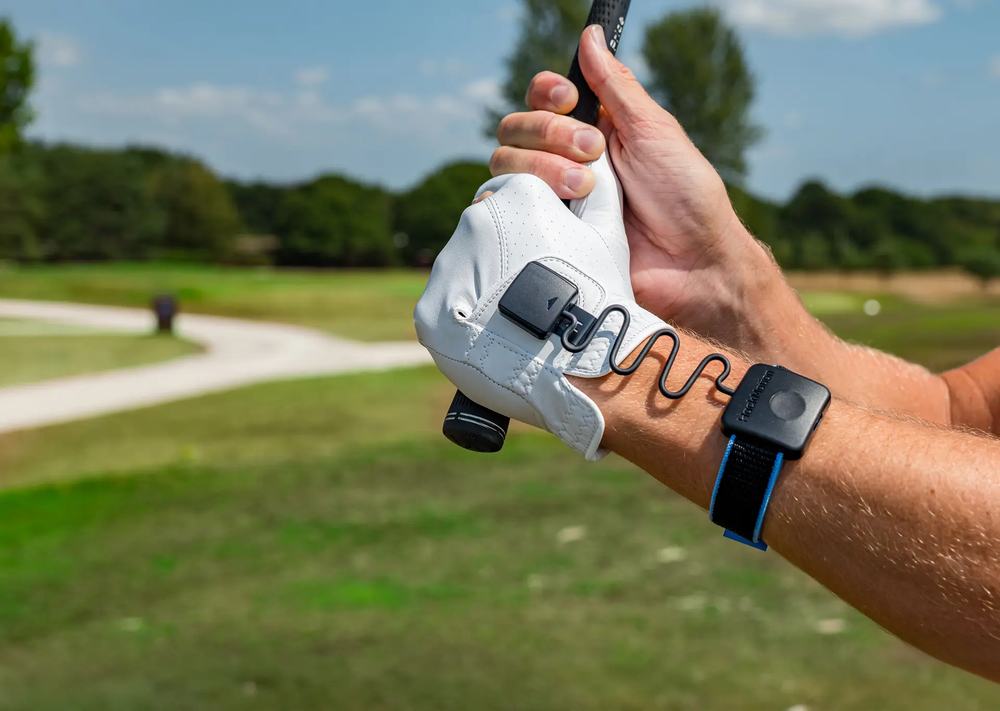
Setup is quick by training-aid standards: strap the sensor on the lead wrist, fit the glove over the Sensor 4's under-glove design, calibrate in a few seconds with a flat wrist, and swing. Sensor 4 improves the wearing experience over Sensor 3 with a smaller soft-rubber housing, three strap sizes, and roughly 26 grams of weight, and reviewers describe it as lightweight and unobtrusive. The app, free on iOS and Android, walks users through analysis and drills, and tier upgrades are software-only at any time, so starting with Core is a low-regret path. The learning curve is real, however: golfers with no grounding in wrist mechanics will need the app's coaching and, ideally, periodic lessons to interpret patterns, and calibration must be repeated each session and whenever the sensor shifts.
Feel and Comfort
Unlike a swing weight or a rigid training brace, HackMotion does not force a position; it measures and signals, leaving the golfer to find the movement. The under-glove fit keeps the device discreet at a public range, and the roughly ten-hour battery with a 2.5-hour USB-C charge supports a full week of practice for most users. Putting mode, on Plus and Pro only, extends the same idea to the stroke, reading wrist stability and running a two-to-one tempo drill; reviewers are split on its value, with some calling it revelatory for face rotation and others judging it closer to a sophisticated tempo tool.
Value
At $345 for Core with Sensor 4, or $275 with the still-sold Sensor 3, which shares the same software and data, HackMotion costs about what a small block of lessons costs, and it keeps working after those lessons end. The one-time, no-subscription pricing, lifetime app updates, free worldwide shipping, 30-day trial, and two-year warranty all strengthen the case, and a $195 trade-in keeps existing owners current. It measures one joint superbly and nothing else: no body rotation, weight shift, club path, or ball flight, and no launch monitor integration. Bought for a known wrist or clubface problem and used weekly, it earns its price; bought speculatively, it likely will not.
Who Should Buy It
Buy HackMotion Core if you fight an open or shut clubface, casting, flipping through impact, or a cupped lead wrist at the top, and you practice often enough to drill with feedback. Choose Plus if putting wrist stability and tempo are also priorities, and Pro mainly if you teach, coach multiple players, or want tour comparison data. Golfers seeking ball-flight numbers or full-body analysis should choose a launch monitor or lessons instead.
Verdict
HackMotion does one job, measuring and training lead-wrist angles, with a depth no general-purpose gadget matches, and Sensor 4 makes that job more comfortable without changing the underlying data. Its narrow focus is both its power and its ceiling: transformative for clubface-control problems, irrelevant for faults rooted elsewhere in the swing. Recommended, starting with Core, for serious practicers battling wrist-related ball-flight issues. This is a research-based review synthesized from published reviews, independent test data, and manufacturer specifications; no personal testing was conducted.
What We Like
- Measures lead-wrist flexion/extension, deviation, and rotation at 800 fps with live audio and haptic biofeedback
- App diagnoses a priority swing fault and assigns guided drills with target ranges based on your data
- Same sensor across all tiers with software-only upgrades and no subscription on any package
- Sensor 4 fits under the glove at about 26 g with roughly 10 hours of battery life
- Plus tier adds putting analysis and tempo drills; Pro adds tour comparisons and multiple profiles
What to Consider
- Measures the lead wrist only; no body rotation, weight shift, club path, or ball-flight data and no launch monitor integration
- Requires some understanding of wrist mechanics to interpret fully; best results come alongside coaching
- Putting mode requires the Plus tier at $490, and Pro tour comparisons raise the price to $985
- Calibration is required every session and whenever the sensor shifts, and infrequent practicers may not use it enough to justify the cost
Specifications
| Sensor System | 2 advanced 6-axis motion sensors; 800 fps wrist motion tracking (Sensor 4: 150 MHz processor, Bluetooth 6.0) |
|---|---|
| Measures | Lead-wrist flexion/extension, radial/ulnar deviation, and rotation at address, top, and impact |
| Battery | About 10 hours continuous practice; 2.5-hour USB-C charge |
| Fit and Weight | Sensor 4: about 26 g, soft rubber housing, fits under a glove, 3 strap sizes (S/M/L) |
| Packages | Core $345 full swing; Plus $490 adds putting; Pro $985 adds tour comparisons, advanced metrics, multiple profiles; no subscription |
| Warranty | 2-year warranty, 30-day trial, free worldwide shipping |
Score Breakdown
Scores are research-based, drawn from manufacturer specs, tour adoption, and published independent test data. How we score
More Training Aids Reviews
All Training Aids →
Callaway
Callaway Alignment Stix
PuttOut
PuttOut Pressure Putt Trainer
Divot Board
Divot Board Swing Training Aid
Orange Whip
Orange Whip Full Size Swing Trainer
TheStack
TheStack System Swing Speed Trainer
Lag Shot
Lag Shot 7 Iron Swing Trainer
DJI
DJI Osmo Pocket 3 Vlogging Camera

EyeLine Golf