
Wilson · Golf Balls Review
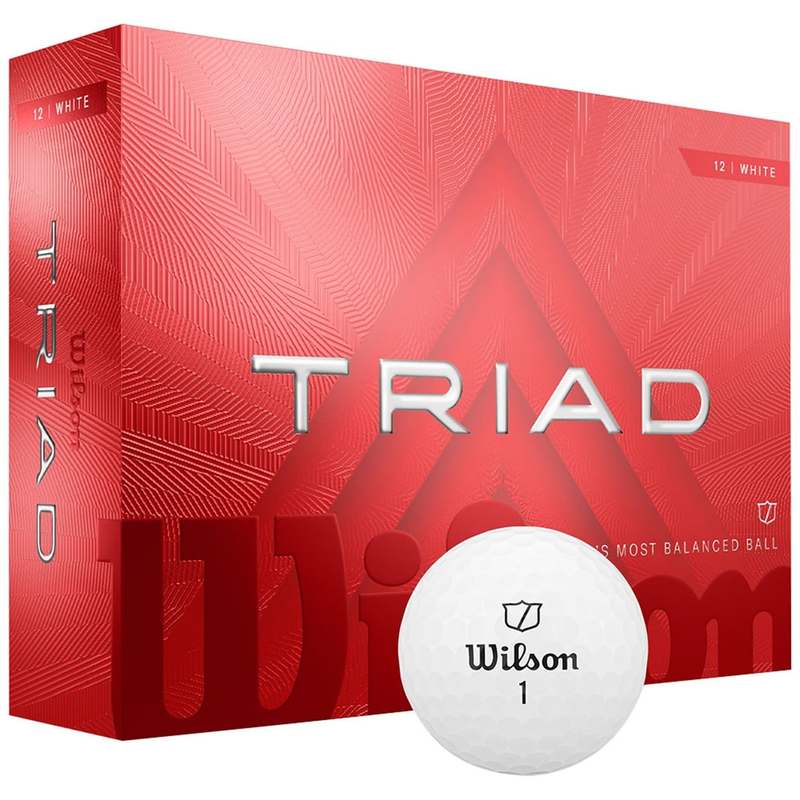
Wilson Triad Golf Balls Review
Urethane balance for breaking 80, at a mid-range price
Very Good
Tour Issue Score 8.5 · Ranked #33 of 76 in Golf Balls
Best for: Mid-handicappers with moderate swing speeds chasing straighter tee shots, predictable iron distances and a truer roll
The Bottom Line
Urethane balance for breaking 80, at a mid-range price. The Wilson Triad Golf Balls scores 8.5 out of 10 in our research-based review, a very good mark that puts it at #33 of 76 Golf Balls in our rankings. Its strongest fit: Mid-handicappers with moderate swing speeds chasing straighter tee shots, predictable iron distances and a truer roll.
Full Review
The Short Version
The Wilson Triad is a three-piece urethane ball built around a single idea: balance. Its Tri-Balanced construction gives all three layers the same density, which Wilson says centers the ball's gravity for a truer roll, while a high-MOI design targets ball speed with restrained driver spin. Wilson positions it for golfers trying to break 80, prices it at $39.99 a dozen, well under flagship tour balls, and refreshed it for 2025 with updated graphics and alignment while keeping the formula that made the 2022 original a quiet success.
Performance
Published robot testing gives the Triad an unusual profile: nothing extreme, almost everything consistent. In Today's Golfer's robot test, the Triad ranked near the top of the entire field for carry-distance consistency and was rated the second-best three-piece club-golfer ball for approach play, even though its raw 7-iron carry and spin numbers were mid-pack. MyGolfSpy's 2025 ball test data tells the complementary story: among Wilson's own balls the Triad produced the lowest spin at every driver speed, translating to rollout and total distance for players who generate enough height, with flatter descent angles and more release on iron shots than the Staff Model line. In other words, this is not a check-and-stop tour ball. It is a straight, stable ball whose scoring value comes from doing the same predictable thing shot after shot, and from an approach game where predictable release beats unpredictable spin for most mid-handicappers.
Forgiveness
Forgiveness in a golf ball is mostly spin management, and the Triad is engineered for calm. Lower driver spin means sidespin has less to work with, so mishits curve less and find more fairways, the entire premise of the high-MOI design. On the greens, Wilson's uniform-density claim targets the other end of the bag: a perfectly centered balance point for putts that start and stay on line. Robot-test consistency supports the tee-to-green version of that argument. The trade is real, though: players who rely on wedge spin to hold firm greens will find the Triad releases where a Staff Model X or Pro V1-class ball grabs, which MyGolfSpy's guidance states plainly, if you struggle to stop approach shots, this is not your ball.
Feel and Sound
At 80 compression the Triad sits in the middle of the modern ball market: firmer than the ultra-soft two-piece balls many amateurs play, softer than flagship tour models. Published on-course verdicts describe a soft, pleasing feel off the putter with a true roll, and feedback that gets more responsive as clubs get shorter, quiet with the driver, communicative with a wedge in hand, helped by the thin, high-friction urethane cover. Golfers who equate softness with quality at all costs may want more squish; golfers who find very soft balls vague will prefer this middle ground.
Value
Value is the Triad's loudest argument. At $39.99 a dozen it undercuts the flagship urethane tier by roughly fifteen dollars while keeping the construction feature that matters most at this level, a real urethane cover, and prior-model stock is frequently discounted further. Against its closest conceptual rivals, urethane balls for moderate swing speeds, it is priced at or below the field, and the robot-test consistency numbers suggest the money buys repeatability rather than a logo.
Who Should Buy It
Buy the Triad if you are a mid-handicapper, roughly the breaking-90-to-breaking-80 band, with a moderate swing speed, enough natural height on approach shots, and a scoring problem defined by wild tee shots and unpredictable iron distances rather than a lack of greenside check. Faster players who flight wedges down and demand maximum spin should step up to Wilson's Staff Model line or another flagship. Beginners losing several balls a round should start cheaper and move up when the loss rate drops.
Verdict
The Wilson Triad does exactly what its name promises: it balances distance, control and roll instead of maximizing any one of them, and it does so at a mid-range price with a urethane cover. Published testing rewards that balance with consistency marks most balls at any price would envy. Recommended for its target player. This is a research-based review: we analyzed specs, manufacturer data, and published independent test data; no personal testing was conducted.
What We Like
- Real cast urethane cover and three-piece construction at $39.99 a dozen, well under flagship tour pricing
- Robot testing ranked its carry-distance consistency near the top of the full test field, predictability is its scoring weapon
- Low-spin, high-MOI design keeps tee shots straighter and adds rollout for players with enough natural height
- Tri-Balanced uniform-density construction is designed for a centered balance point and a true putting roll
What to Consider
- Wedge and approach spin run below flagship tour balls, so shots release rather than check on firm greens
- Raw ball speed and carry numbers are mid-pack in robot testing, it wins on consistency, not headlines
- 80 compression is firmer than the ultra-soft balls many amateurs expect at this price
Specifications
| Compression | 80 |
|---|---|
| Construction | 3-piece with thin, high-friction cast urethane cover |
| Dimples | 362 |
| Flight | Mid launch, low driver spin; available in white and yellow |
| Key Tech | Tri-Balanced Construction (uniform density across all three layers); high-MOI design |
| Target Player | Moderate swing speeds; positioned by Wilson for golfers chasing breaking 80 |
Score Breakdown
Scores are research-based, drawn from manufacturer specs, tour adoption, and published independent test data. How we score
More Balls Reviews
All Balls →
Titleist
Titleist Pro V1x Golf Balls (2025)
Callaway
Callaway Chrome Tour X Golf Balls
Titleist
Titleist Pro V1 Golf Balls (2025)
Callaway
Callaway Chrome Tour Triple Diamond Golf Balls
Srixon
Srixon Z-Star Diamond Golf Balls
Maxfli
Maxfli Tour X Golf Balls
Srixon
Srixon Z-STAR XV DIVIDE Golf Balls
TaylorMade