Tour Edge · Irons Review
Tour Edge Exotics C725 Irons Review
Forged-face players-distance speed and standout feel, hundreds under the big names
Excellent
Tour Issue Score 8.7 · Ranked #50 of 67 in Irons
Best for: Single-digit to low-mid handicappers who want players-distance ball speed and workability in a compact, thin-toplined hollow-body head
The Bottom Line
Forged-face players-distance speed and standout feel, hundreds under the big names. The Tour Edge Exotics C725 Irons scores 8.7 out of 10 in our research-based review, a excellent mark that puts it at #50 of 67 Irons in our rankings. Its strongest fit: Single-digit to low-mid handicappers who want players-distance ball speed and workability in a compact, thin-toplined hollow-body head.
Full Review
The Short Version
The C725 is the better-player entry in Tour Edge's Exotics 725 iron family: a hollow-body players-distance iron that shrinks the head 10 percent, thins the topline and sole, and hides a serious amount of speed technology inside a shape a single-digit player can look down at. A forged maraging steel face, VIBRCOR gel in the cavity and a 3D Diamond Face do the work. Golf Monthly tested it head-to-head against the Ping i530, Callaway Apex Pro and Mizuno Pro 245 and found comparable distance, exceptional feel and real workability. At $899.99 for a seven-piece steel set, it undercuts every one of those rivals. Its flaws are specific: an occasional hot strike, no left-handed option, and forgiveness that is only medium by design.
Performance
The distance is legitimate and it comes from the face. Tour Edge plasma-welds a forged, military-grade maraging steel face onto a 17-4 stainless body, and the L-shaped face wraps into the sole so it hinges at impact. Golf.com's 725 family coverage, via Golf Digest's Jonathan Wall, describes the hollow body placing the center of gravity low and deep for a higher flight, with the 7-iron at a modern players-distance loft of 30 degrees. Golf Monthly's on-course and range testing found distance output comparable to the category's biggest names, credited to impressive ball speed, and found the irons surprisingly workable for varying trajectory. The caveat from that same test matters: two shots out of roughly a hundred came off noticeably hotter, 3 to 4 mph more ball speed and 10 to 12 yards long. That is the known tax on thin-faced hollow-body designs, and a player who flies greens on pure strikes should weigh it.
Forgiveness
Forgiveness here is best described as well-engineered for its class, not maximal. The hollow body allows full perimeter weighting, and the 3D Diamond Face places 92 diamond-shaped zones of varying thickness behind the face to keep speed up away from center. Within the 725 family, though, Tour Edge itself rates the C725 at medium forgiveness: it has the shortest blade length, thinnest topline and least offset of the three models, and the E725 and X725 exist for players who need more help. Better players will find mishits lose less than a blade or a compact cavity would cost them. Struggling ball-strikers will find the limit quickly, and Tour Edge's own lineup tells them where to go instead. One genuine fitting plus: the 14-gram weight behind the impact zone is interchangeable, so a fitter can set swing weight precisely for length and preference.
Feel and Sound
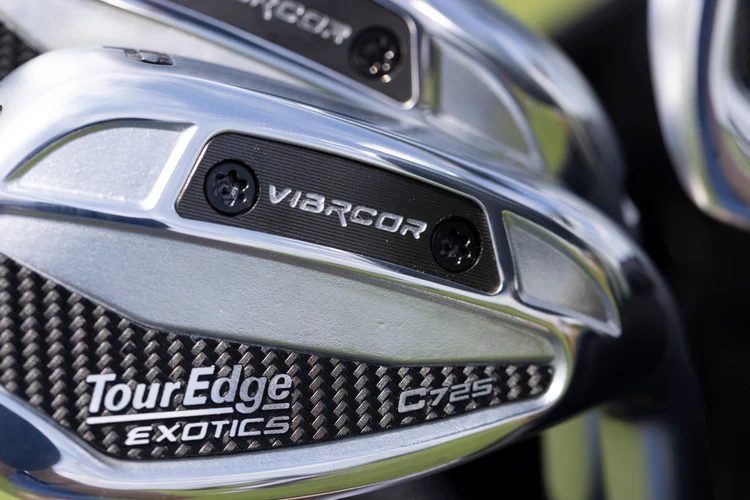
Feel is the surprise strength. Hollow-body distance irons often sound hollow and clicky; the C725 largely avoids it because VIBRCOR, a thermoplastic polyurethane gel, is injected into the cavity to damp vibration while supporting face flex. Golf Monthly called the feel exceptional, a lively combination of speed and softness, and that verdict is notable because the same test was willing to criticize the jumpy strikes. The player-preferred shaping helps the impression at address too: a shorter blade, thin topline and minimal offset present like a players iron, not a game-improvement shovel wearing a disguise. For golfers who want distance help without giving up feedback on strike location, the C725 threads the needle better than most of the category.
Value
Value is where Tour Edge has built its reputation, and the C725 is a clean example. At $128.99 per club in steel, $899.99 for a seven-piece set, or $142.99 per club and $999.99 in Project X Denali Blue graphite, it lands several hundred dollars under comparably specified sets from Ping, Callaway and Mizuno, while offering a forged face, an adjustable fitting weight and a lifetime-limited warranty culture the brand is known for. Golf Monthly's closing verdict was that it belongs on anyone's test list in the compact distance category. Nothing in the published research contradicts that. The only value caution is resale and fitting access: Tour Edge's retail footprint is smaller than the giants, so demo before you buy if you can.
Who Should Buy It
Buy the C725 if you are a single-digit or improving low-mid handicapper who wants more ball speed and a higher flight without moving to a bulky game-improvement head, and who still wants to flight the ball and work it both ways. It suits players who like a compact look and will use a fitter to set the adjustable weight and check gapping, especially at the strong-lofted scoring end. Skip it if you are right-handed only by accident of reading this far and actually play left-handed, since there is no left-handed build, if your strike needs maximum help, where the E725 and X725 are the honest picks, or if occasional 10-yard flyers would wreck your course management.
Verdict
The C725 earns its place in the players-distance conversation on merit: verified ball speed against the best in class, feel that reviewers singled out for praise, and a price that undercuts the field by hundreds. Its limits, medium forgiveness, strong lofts and the odd hot shot, are documented and manageable for its target player. If you fit that description, this is one of the best value irons of 2025. Recommended. This is a research-based review synthesized from published reviews, independent test data, and manufacturer specifications; no personal testing was conducted.
What We Like
- Hollow-body construction with a forged military-grade maraging steel L-cup face plasma-welded to a 17-4 stainless body, the thinnest face in Exotics history, per Tour Edge
- Ball speed and distance comparable to the Ping i530, Callaway Apex Pro and Mizuno Pro 245 in Golf Monthly's testing, from a smaller head
- VIBRCOR TPU injected into the cavity delivers the lively but soft feel Golf Monthly called exceptional, with genuine workability to vary trajectory
- 3D Diamond Face with 92 diamond-shaped variable-thickness areas protects speed on off-center strikes
- 14-gram adjustable back weight lets fitters dial swing weight precisely, a fitting touch rarely offered at this price
- $899.99 for a seven-piece steel set ($999.99 in graphite), well under the big-name players-distance sets it tests against
What to Consider
- Occasional hot shots: Golf Monthly noted two jumpy strikes in roughly a hundred that flew 10 to 12 yards long, a distance-control caveat for scoring clubs
- Right-hand only across the set, which shuts left-handers out entirely
- Medium forgiveness by design: it is the least forgiving of the three Exotics 725 irons, so high-handicappers should look at the E725 or X725 instead
- Strong lofts (30-degree 7-iron) can compress gapping at the bottom of the set, and MyGolfSpy flagged blending issues with the newer Exotics MB and CB lofts
Specifications
| Construction | Hollow body, forged maraging steel L-cup face plasma-welded to 17-4 stainless steel body, VIBRCOR TPU in cavity |
|---|---|
| Face | 3D Diamond Face, 92 variable-thickness diamond areas; 14g adjustable back weight |
| Grip | Golf Pride Tour Velvet 360 Black |
| Set and Lofts | 4-PW plus AW, right-hand only; 4-iron 21 degrees, 7-iron 30 degrees, PW 44 degrees |
| Shafts | True Temper Dynamic Gold Mid 100 steel or Project X Denali Blue 80 graphite |
Score Breakdown
Scores are research-based, drawn from manufacturer specs, tour adoption, and published independent test data. How we score