
Top Flite · Golf Balls Review
Top Flite Gamer Golf Balls Review
Cheap on the shelf, average in the lab, and one in four balls flagged bad
Below Average
Tour Issue Score 6.3 · Ranked #63 of 76 in Golf Balls
Best for: Budget focused beginners and high handicappers who lose a lot of balls and do not yet rely on greenside spin
The Bottom Line
Cheap on the shelf, average in the lab, and one in four balls flagged bad. The Top Flite Gamer Golf Balls scores 6.3 out of 10 in our research-based review, a below average mark that puts it at #63 of 76 Golf Balls in our rankings. Its strongest fit: Budget focused beginners and high handicappers who lose a lot of balls and do not yet rely on greenside spin.
Full Review
The Short Version
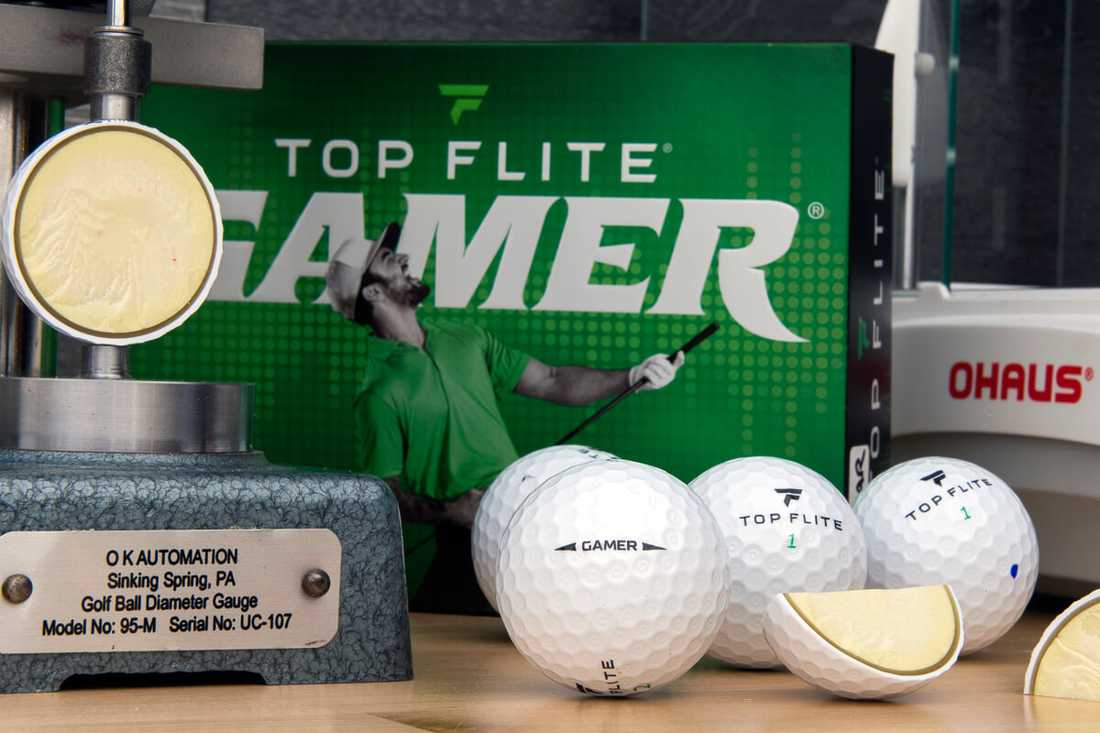
The Top Flite Gamer is a three piece ionomer ball sold as the house brand of DICK'S Sporting Goods for $22.99 a dozen, and it promises tour style versatility, distance, soft feel and greenside control, at a rock bottom price. The independent evidence supports only part of that promise. MyGolfSpy Ball Lab, the most rigorous ball quality program in the game, scored the Gamer 65 out of 100, solidly average, and flagged a quarter of its sample as bad balls. The Gamer is not a scam and it is not a hidden gem. It is an average ionomer ball whose quality control is weak enough that its real cost per good dozen is 38 percent higher than the sticker, in a price bracket where better documented urethane balls now exist in our own catalog.
Performance
Off the driver the Gamer does its best work. Compression measured 77 on the Ball Lab gauge, similar to the Titleist Velocity among ionomer balls, and the firm, low spin character suits moderate swing speeds, producing a stable, penetrating flight. Rick Shiels recorded carry distances around 275 yards at his speed with spin near 2,200 rpm and rated distance a strong 8 to 9 out of 10, while noting the box claim of 11 out of 10 distance was not met. The problem is what happens as the clubs get shorter. An ionomer cover, however soft the marketing calls it, cannot grip the grooves like urethane, so wedge shots and chips spin less, check less and release more. Published member testing on the MyGolfSpy forum summed the ball up fairly: a jack of all trades and master of none, not noticeably longer or shorter than rivals, and not a ball that improved scores.
Forgiveness
For a golf ball, forgiveness means consistency: every ball in the dozen should fly the same. That is exactly where the Gamer's research record is weakest. Ball Lab's cut open inspection found multiple concentricity problems, most often uneven mantle thickness with extreme thin spots, and occasionally thin spots in the cover. One ball in the sample was missing a section of its dimple pattern, and a few cores contained visible chunks of foreign material. In total, 25 percent of the sample was flagged bad, the finding behind the True Price math. The measured basics were fine, weight, diameter and compression consistency all graded average and every ball met USGA limits, and the ball is classified large, which helps stability. But a ball built off center can fly offline on a good swing, and at a one in four bad rate, the dozen in your bag is not the dozen you think you bought.
Feel and Sound
Feel is firmer than the packaging implies. At 77 compression the Gamer sits about 10 points firmer than the leaders in its own premium ionomer class, and Ball Lab noted a roughly 10 point compression spread across the sample, so two sleeves from the same box can feel noticeably different. Around the green the firm ionomer surface gives a clicky, lower spin response on chips and putts that better players tend to reject quickly. Durability is the one place the firm cover helps: bunker testing published by Rick Shiels left scuff marks after ten shots but nothing that forced the ball out of play, and ionomer covers generally shrug off cart paths and tree strikes that shred soft urethane. Expect a ball that lasts, not a ball that feels premium.
Value
The sticker says value, the math says otherwise. Ball Lab's True Price, what you must spend to be confident of getting twelve good balls, is $31.83 against the $22.99 retail price. At that effective price the Gamer is no longer competing with two piece range balls; it is competing with real urethane balls that spin more and are built tighter, including the Maxfli Tour in this catalog at $39.99 a dozen with frequent multi dozen promotions that pull its effective price toward $30, and the Srixon Q-Star Tour, another catalog urethane option built for moderate swing speeds. Promotions soften the blow, two dozen Gamers for $35 is genuinely cheap golf, but value measured per good ball, not per box, is mediocre.
Who Should Buy It
The Gamer still has one honest audience: beginners and high handicappers who lose several balls a round, play mostly driver, iron and putter golf, and do not yet hit checking wedge shots. For that player, at a promotional price, it is a durable, conforming, respectable ball. Everyone else should avoid it, and that includes improving players learning to spin the ball, anyone who plays competitively, and any golfer frustrated by the occasional inexplicable offline shot, because the Ball Lab data says some of those shots are the ball, not the swing. The better alternative is the Maxfli Tour reviewed on this site: cast urethane greenside spin, a durable cover in long term testing, and a price that promotions bring close to the Gamer's True Price.
Verdict
Score the Gamer where its research lands: a 65 out of 100 in the lab, a quarter of the sample defective, ionomer greenside performance in a market that now sells affordable urethane, and a True Price that undercuts its one great claim. It is playable, durable and cheap on promotion, and it is still not recommended when better documented balls sit one shelf up. This is a research-based review synthesized from published reviews, independent test data, and manufacturer specifications; no personal testing was conducted.
What We Like
- At $22.99 a dozen, with frequent two for $35 promotions at DICK'S and Golf Galaxy, it is among the cheapest three piece balls sold
- Weight, diameter and compression consistency all graded solidly average in Ball Lab testing, with every ball conforming to USGA limits
- Firm ionomer cover resists cutting and heavy scuffing better than soft urethane covers at this price in published play testing
- Driver distance is respectable for moderate swing speeds, and the large diameter profile flies stable in the wind
What to Consider
- MyGolfSpy Ball Lab flagged 25 percent of its sample as bad balls, driven by concentricity defects and extreme thin spots in the mantle layer
- Ionomer cover cannot produce urethane class greenside spin or check, so better players will watch chips and pitches release instead of grabbing
- Ball Lab True Price is $31.83, 38 percent above the $22.99 retail price, which quietly erases much of the bargain once bad balls are counted
- Firmer than the leading premium ionomer balls at 77 measured compression, with a 10 point compression spread across the sample, so feel and flight vary ball to ball
Specifications
| Compression | 77 average measured in MyGolfSpy Ball Lab; about 10 point spread across the sample |
|---|---|
| Construction | 3-piece: high energy core, DuPont HPF mantle layer, firm ionomer cover |
| Dimples | Dimple in Dimple aerodynamics |
| Quality Data | Ball Lab score 65 of 100; 25 percent of sample flagged bad; True Price $31.83 vs $22.99 retail |
| Size and Availability | Classified large diameter, all sample balls USGA conforming; sold at DICK'S Sporting Goods and Golf Galaxy |
Score Breakdown
Scores are research-based, drawn from manufacturer specs, tour adoption, and published independent test data. How we score
More Balls Reviews
All Balls →
Titleist
Titleist Pro V1x Golf Balls (2025)
Callaway
Callaway Chrome Tour X Golf Balls
Titleist
Titleist Pro V1 Golf Balls (2025)
Callaway
Callaway Chrome Tour Triple Diamond Golf Balls
Srixon
Srixon Z-Star Diamond Golf Balls
Maxfli
Maxfli Tour X Golf Balls
Srixon
Srixon Z-STAR XV DIVIDE Golf Balls
TaylorMade