
Pinnacle · Golf Balls Review
Pinnacle Rush Golf Balls Review
Measured longest with the irons, measured near last around the greens
Below Average
Tour Issue Score 6.4 · Ranked #58 of 76 in Golf Balls
Best for: Distance first beginners and high handicappers who play run up shots, lose balls often, and rarely chip for position
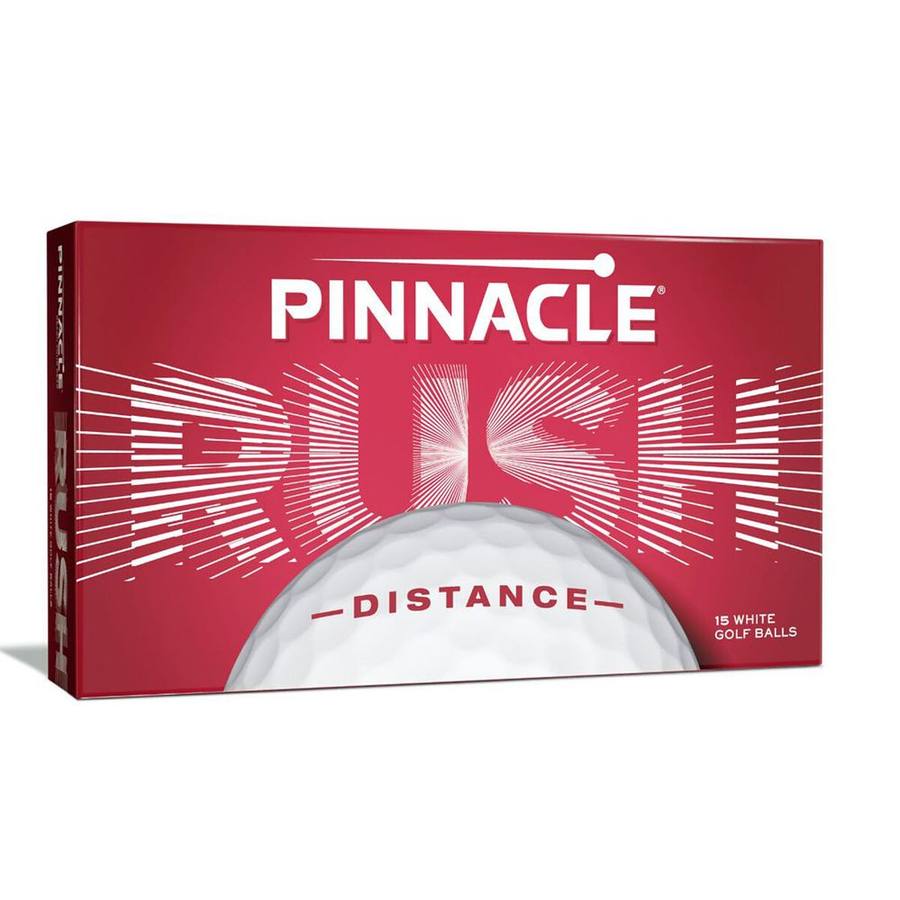
The Bottom Line
Measured longest with the irons, measured near last around the greens. The Pinnacle Rush Golf Balls scores 6.4 out of 10 in our research-based review, a below average mark that puts it at #58 of 76 Golf Balls in our rankings. Its strongest fit: Distance first beginners and high handicappers who play run up shots, lose balls often, and rarely chip for position.
Full Review
The Short Version
The Pinnacle Rush is a two piece distance ball made by Acushnet, the company behind Titleist, and sold in 15 ball packs for about $20. The distance story is real and measured: in MyGolfSpy's 2025 golf ball test it was the longest iron ball in the mid swing speed test. The problem is the other half of the same dataset. On a 35 yard wedge shot the Rush spun at 3,227 rpm, barely half the 6,026 rpm of the test leader, which makes it one of the lowest spinning balls around the green in the entire test. A ball can be long or it can be controllable. The Rush chose, and the choice caps its score.
Performance
Credit first, because the data earns it. MyGolfSpy's 2025 test recorded the Rush as the longest mid iron ball for mid swing speed golfers at 161.2 yards, against a test average of 154.5 yards, thanks to a hot, low to mid spin flight. Golf Monthly's on course review found the same thing in human hands, reporting one to two clubs of extra iron distance and a high, stable flight. Then the scoring shots arrive. MyGolfSpy lists the Rush at 3,227 rpm on the 35 yard wedge test in two separate analyses, against roughly 5,700 to 6,000 rpm for tour urethane balls, and describes it plainly as a fast, firm ball whose Surlyn cover gives up a lot of control. Shots that land hot and release through the green hand back the yards the long game won.
Forgiveness
Off the tee, the low spin flight is genuinely forgiving: sidespin is reduced, so slices and hooks curve less, and the durable ionomer cover shrugs off cart paths and tree strikes. Around the green, forgiveness disappears. There is no check on chips and no grab on pitches, so beginners must learn to play for a release they cannot vary, and Golf Monthly warns that the extra one to two clubs of iron distance means yardages change enough that swapping between the Rush and a softer ball wrecks distance control. A ball whose approach shots will not hold and whose distances sit a club apart from everything else in the category is not forgiving where scoring happens.
Feel and Sound
Firm is the consensus word. MyGolfSpy calls the Rush fast and firm, Today's Golfer lists a decent feel off the clubface as a plus but pairs it with a con for the lack of greenside spin, and Golf Monthly's tester, who likes a firmer ball, still frames the Rush against the clicky reputation of out and out distance balls. Off the putter the response is hard and uninformative compared with the soft, low compression balls that now dominate this price bracket. If feel on short shots matters to you, the research says this is the wrong end of the category.
Value
A 15 ball pack at $19.99 looks like a bargain until the comparison is made inside the same budget shelf. Today's Golfer lists 'not the cheapest option in this category' as a con, and our own catalog shows why: the Srixon Soft Feel (8.1 out of 10) and the TaylorMade SpeedSoft (8.2 out of 10) sell at $24.99 a dozen with softer feel and meaningfully better greenside behavior, the Srixon backed by strong ionomer spin numbers and the SpeedSoft by published robot testing. Five extra dollars buys a ball that can actually check. The Rush only wins the value argument if raw iron distance is the single thing being purchased.
Who Should Buy It
Buy it only if you are a distance obsessed beginner on open, firm courses, you lose balls regularly, and you play run up shots by choice. Avoid it if you chip and putt for score, if your home greens are firm and fast, if you are learning distance control, or if you dislike a firm, clicky feel. Those golfers should read our Srixon Soft Feel and TaylorMade SpeedSoft reviews instead: same budget family, far more complete balls.
Verdict
The Rush is a one trick ball, and the trick is measured, real, and not enough. Longest in its iron test, near last in greenside spin, firm in hand, and priced within five dollars of budget balls that do everything better except fly quite as far. Distance alone does not make a golf ball good. This is a research-based review synthesized from published reviews, independent test data, and manufacturer specifications; no personal testing was conducted.
What We Like
- Longest mid iron ball in MyGolfSpy's 2025 mid swing speed test at 161.2 yards against a 154.5 yard test average
- Low spin driver flight reduces slice and hook curvature for beginners
- Tough ionomer cover resists cuts and holds up over many rounds
- 15 ball pack from Acushnet at a budget price, in white and optic yellow
What to Consider
- Measured 3,227 rpm on MyGolfSpy's 35 yard wedge test, barely half the 6,026 rpm test leader, so chips and pitches release instead of checking
- Firm, clicky feel off the wedges and putter, a generation behind the soft budget balls in its price class
- Low spin flight lands hot and runs through greens, giving back on approaches what it gains off the tee
- Not the cheapest ball in its category per Today's Golfer, and softer catalog rivals with better spin cost only about $5 more per dozen
Specifications
| Colors | White and optic yellow |
|---|---|
| Construction | 2 piece |
| Cover | Ionomer cover |
| Dimples | 332 icosahedral dimple design |
| Pack Sizes | 15 ball pack |
Score Breakdown
Scores are research-based, drawn from manufacturer specs, tour adoption, and published independent test data. How we score
More Balls Reviews
All Balls →
Titleist
Titleist Pro V1x Golf Balls (2025)
Callaway
Callaway Chrome Tour X Golf Balls
Titleist
Titleist Pro V1 Golf Balls (2025)
Callaway
Callaway Chrome Tour Triple Diamond Golf Balls
Srixon
Srixon Z-Star Diamond Golf Balls
Maxfli
Maxfli Tour X Golf Balls
Srixon
Srixon Z-STAR XV DIVIDE Golf Balls
TaylorMade