Cobra · Irons Review
Cobra KING Irons (2026) Review
3D printing trickles down: low center of gravity speed at a $999 game improvement price
Excellent
Tour Issue Score 8.7 · Ranked #45 of 72 in Irons
Best for: Mid to high handicappers (roughly 10 to 20) with moderate to faster swing speeds who want speed, height and forgiveness without an oversized head
The Bottom Line
3D printing trickles down: low center of gravity speed at a $999 game improvement price. The Cobra KING Irons (2026) scores 8.7 out of 10 in our research-based review, a excellent mark that puts it at #45 of 72 Irons in our rankings. Its strongest fit: Mid to high handicappers (roughly 10 to 20) with moderate to faster swing speeds who want speed, height and forgiveness without an oversized head.
Full Review
The Short Version
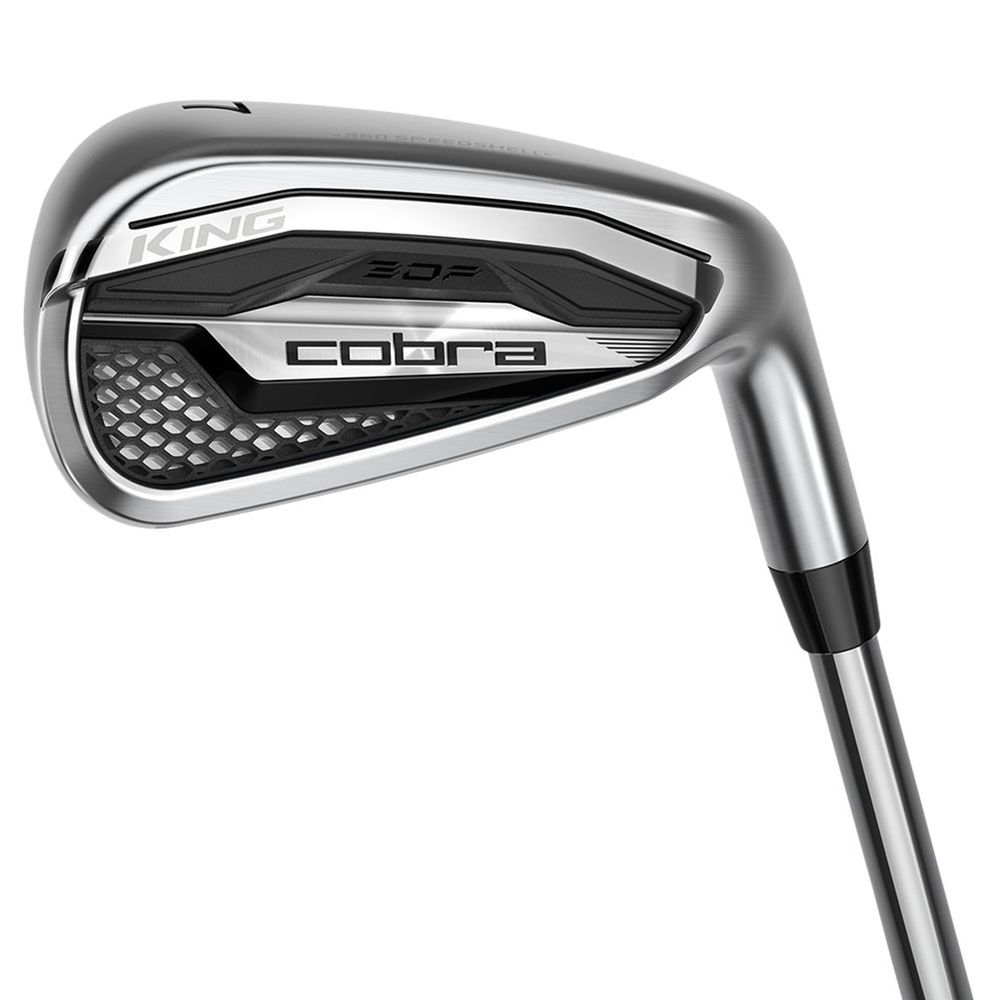
The Cobra KING irons for 2026 are Cobra's mainstream game improvement set, priced below its 3DP and King Tour families, and they borrow a surprising amount of thinking from those premium lines. The cast cavity back head uses a 3D printed medallion in the cavity to save weight and drop the center of gravity, a 360 SPEEDSHELL face insert for more flex, an 80 gram catapult weight low in the head, and a redesigned SKID SOLE for cleaner turf interaction. GOLF.com places the standard KING for players seeking maximum speed with a boost in launch and a steeper descent angle, in the 10 to 20 handicap range. At $999 in steel, it undercuts the Callaway Quantum sets in this batch on headline price while offering a distinct technology story of its own.
Performance
Cobra says the 360 SPEEDSHELL insert, which wraps toward the sole and uses H.O.T. variable thickness geometry, allows about 23 percent more face flex than the previous generation, a figure repeated across GOLF.com, the launch coverage and independent reviews. The 80 gram catapult weight, suspended in a shock absorbing polymer and 15 grams heavier than the DS-ADAPT equivalent, is intended to maximize energy transfer while damping vibration. Independent launch monitor testing published by Golf Sidekick recorded 124 mph ball speed, 176 yards of carry and 189 yards total with the 29 degree 7 iron, at a 19.8 degree launch and 5,950 rpm of spin, with a 1.45 smash factor. That spin figure is notable in a strong lofted game improvement iron, because it supports the steeper landing angle Cobra promises rather than a low spinning flight that runs through greens. Golf Monthly's buying guide also highlights potent distance and a high launching flight, and named the KING its best wide appeal Cobra iron for 2026.
Forgiveness
The forgiveness mechanism is weight placement. The 3D printed ABS medallion uses a lattice structure to save up to about 5 grams, which Cobra redistributes to drop the center of gravity by about 2 mm compared with the DS-ADAPT. Combined with the deep catapult weight, that low center of gravity helps launch and keeps speed on strikes away from center. Golf Sidekick specifically noted tight distance dispersion even when strike quality dropped, crediting the SPEEDSHELL face and the redistributed weight. The boundary is model choice: the KING MAX sibling offers a larger blade, more offset, 2 degree weaker lofts and a draw biased center of gravity for moderate swing speeds and slice prone players. The standard KING is the faster, cleaner option of the pair, and Cobra internal figures cited in coverage put it about 1.4 mph faster and about 5 yards longer on average than the KING MAX.
Feel and Sound
Feel in a cast, multi piece game improvement iron depends heavily on vibration control, and Cobra attacks it in two places: the polymer suspended catapult weight and the lattice medallion, which also tunes acoustics. Golf Monthly describes a blend of classic looks with modern engineering, and reviewers generally characterize the KING as firm, responsive and stable rather than soft. Golfers expecting forged feedback should set expectations accordingly and compare the King Tour or 3DP lines. For its price class, the published consensus is that sound and feel are well managed rather than a weakness, with no recurring harshness complaint dominating coverage in the way sound divides opinion on some oversized rivals.
Value
Value is the KING's strongest card in this batch. At $999 for steel and $1,099 for graphite, in 5-GW or 4-PW makeups per GOLF.com, it brings trickle down 3D printing, a heavy low weight and a current generation face to a price point below the $1,149.99 seven piece Quantum launch pricing and below Cobra's own premium irons by a wide margin. The SKID SOLE adds practical value that does not show up on a launch monitor: derived from the Phil Rogers wedge sole, it uses a pre worn leading edge, added bounce and a flatter mid sole to help both steep and shallow players, and Golf Sidekick called it one of the more tangible on course benefits. The main value caution is fitting breadth at retail stock, where the KBS Tour Lite steel and KBS PGI graphite options will not suit every swing weight preference without custom ordering.
Who Should Buy It
Buy the standard KING if you are a 10 to 20 handicapper with a moderate to faster swing who wants distance, height and forgiveness without moving to an oversized super game improvement head. It particularly suits players who hit down on the ball and can use the SKID SOLE help through turf. Choose the KING MAX instead if you swing more moderately, fight a slice, or want weaker lofts and more offset. Choose a Quantum Max if you prefer Callaway's undercut feel and shaping, and choose a players iron if workability matters more than launch help.
Verdict
The 2026 KING is a competent, honestly priced game improvement iron that delivers on its claims in the published testing: real ball speed, useful spin for its loft, tight dispersion on poor strikes and a sole design reviewers could actually feel helping. Its technology story, 3D printing used for weight savings rather than decoration, is the clearest point of difference in this batch. This is a research-based review: we analyzed specs, manufacturer data, and published independent test data; no personal testing was conducted.
What We Like
- 3D printed lattice medallion saves weight and drops the center of gravity about 2 mm versus the DS-ADAPT, per Cobra and GOLF.com
- 360 SPEEDSHELL face insert with H.O.T. geometry delivers about 23 percent more face flex than the previous generation
- 80 gram catapult weight, 15 grams heavier than in DS-ADAPT, suspended in shock absorbing polymer for energy transfer and vibration control
- Independent launch monitor testing recorded 124 mph ball speed, 176 yards carry and 5,950 rpm spin with the 7 iron
- SKID SOLE with pre worn leading edge improves turf interaction for both steep and shallow players, praised in independent reviews
What to Consider
- Cast multi piece feel is firm and responsive rather than forged soft, so feel first players should compare King Tour or 3DP
- Standard KING has less offset and no draw bias compared with the KING MAX, so slice prone moderate swingers may need the sibling model
- Stock KBS Tour Lite and KBS PGI options may require custom ordering to suit heavier shaft preferences
- Strong 7 iron loft at 29 degrees requires careful wedge gapping, as with most game improvement sets
Specifications
| Key Tech | 3D printed ABS lattice medallion, 360 SPEEDSHELL face insert with H.O.T. variable thickness, 80g catapult weight in shock absorbing polymer, redesigned SKID SOLE |
|---|---|
| Lofts | 7 iron 29 degrees (standard KING); set available 4 iron through sand wedge, with stock sets in 4-PW and 5-GW |
| Set Composition | 4-PW and 5-GW stock makeups (RH/LH varies by flex) |
| Shaft Options | KBS Tour Lite steel; KBS PGI graphite (85g stiff, 75g regular, 65g lite); SuperStroke Crossline 360 grip |
Score Breakdown
Scores are research-based, drawn from manufacturer specs, tour adoption, and published independent test data. How we score