Callaway · Irons Review
Callaway Quantum Max OS Irons Review
The oversized, maximum forgiveness Quantum for golfers who need the most help
Very Good
Tour Issue Score 8.6 · Ranked #55 of 72 in Irons
Best for: High handicappers, seniors and slower swingers (roughly 68 to 90 mph) who miss thin or toward the toe and want maximum launch and forgiveness
The Bottom Line
The oversized, maximum forgiveness Quantum for golfers who need the most help. The Callaway Quantum Max OS Irons scores 8.6 out of 10 in our research-based review, a very good mark that puts it at #55 of 72 Irons in our rankings. Its strongest fit: High handicappers, seniors and slower swingers (roughly 68 to 90 mph) who miss thin or toward the toe and want maximum launch and forgiveness.
Full Review
The Short Version
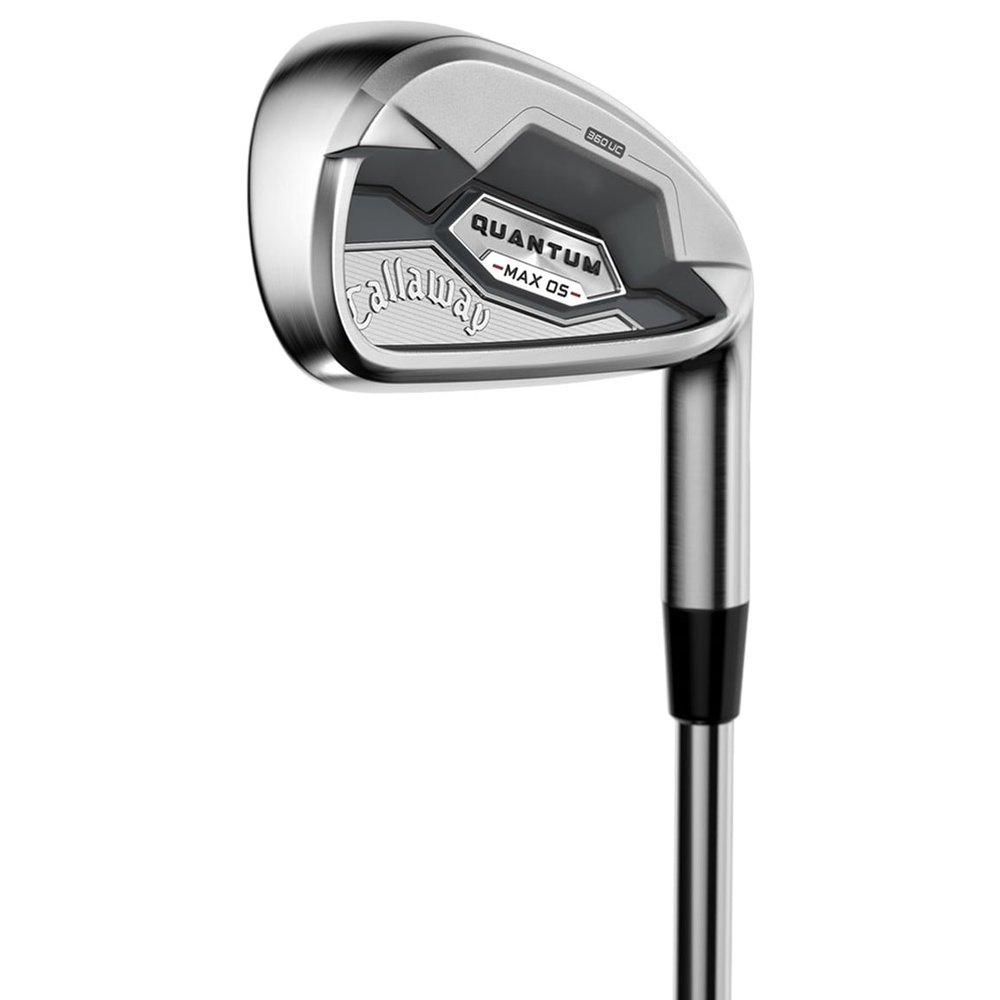
The Quantum Max OS is the super game improvement member of Callaway's 2026 Quantum iron family. OS stands for oversized, and that is the whole point: a larger head, a thicker topline, a wider sole and substantially more offset than the standard Quantum Max, built for golfers who want maximum help launching the ball and keeping mishits playable. It shares the core Quantum technology, the Modern 360 Degree Undercut Cavity, the next generation AI optimized face, the Progressive Tri-Sole and urethane microspheres, but packages it in the most forgiving shape Callaway makes in this line. Golf Digest awarded it a 2026 Hot List Gold medal with a 5.0 score in the super game improvement category.
Performance
The OS uses the same loft ladder as the standard Max, from a 19 degree 4 iron to a 55 degree sand wedge, with the 7 iron at 29 degrees. Golf Digest specifically notes weaker lofts relative to some rivals in this oversized class as part of how the OS helps golfers get the ball airborne, and Callaway also offers a custom High Launch spec adding a further 2 degrees through the set. Published comparisons suggest raw distance is essentially level with the standard Max rather than longer: Golfstead found no meaningful ball speed difference between the OS and the Max in its testing, and National Club Golfer testing cited in secondary coverage found the OS pitching wedge carrying about 3 yards shorter than the standard Max, with higher launch and spin. That trade is intentional. The OS buys height, stability and playable mishits, and pays for it with a fraction of top end carry for better strikers.
Forgiveness
This is the most forgiving iron in the Quantum lineup, and forgiveness is where the OS separates itself. The oversized profile allows a deeper cavity and a lower center of gravity, and the offset is markedly larger: 6.35 mm in the 4 iron and 4.80 mm in the 7 iron, compared with 5.08 mm and 3.71 mm in the standard Max. National Club Golfer coverage praised exceptional stability on mishits with consistent carry even on off center contact, and Golf Digest's Hot List panel recorded tight dispersion and strong carry for the category. A 13 handicap Hot List tester quoted by Golf Digest praised spectacular feel, ball flight, launch and dispersion, and said the club crashes the ball out to the target. For thin and toe side misses in particular, multiple sources position the OS as the safer choice.
Feel and Sound
Feel is the divided topic. Golf Digest testers described a firm and satisfying strike, Golf Monthly's tester found a lively and powerful sensation, and Plugged In Golf described a firm, explosive thwack that felt good relative to its category. MyGolfSpy testers, by contrast, found the sound unappealing in coverage summarized by The Golf Ace. Urethane microspheres clearly improve the OS over a bare hollow game improvement head, but no source claims a soft forged feel, and Plugged In Golf warns buyers not to expect one. Golfers who are sensitive to sound should demo the OS before buying, ideally outdoors where super game improvement heads sound different than they do in a bay.
Value
Priced at the same TGW set level as the standard Quantum Max, the OS asks no premium for its extra size and offset, which strengthens its value case for its target player. It also carries broad stock choice, including the True Temper Elevate Black 85 steel shaft and Denali Frost Silver and Mitsubishi Vanquish graphite options, plus the High Launch custom spec. The value limit is audience size: if you are below roughly a 15 handicap and strike the ball reasonably well, several reviewers conclude the standard Max is the better buy at the same money, because you give up little forgiveness and gain a cleaner head and slightly stronger wedge carry.
Who Should Buy It
Buy the Max OS if you are a high handicapper, a senior golfer, or a player swinging roughly 68 to 90 mph whose common misses are thin or toward the toe, and who values launch and forgiveness ahead of shot shaping. It is also a sensible pick for a returning golfer who wants confidence from a large head at address. Do not buy it as a default upgrade from the standard Max if you already launch the ball well: the performance gap is small, and the decision should be made at address, by which head you trust more.
Verdict
The Quantum Max OS does exactly what a super game improvement iron should do: maximum forgiveness, high launch and stable carry in a shape that reviewers agree looks cleaner than most of its class. It scores slightly below the standard Max here only because its audience is narrower and its feel divides testers, not because it fails its brief. For the golfer it was designed for, it is one of the strongest options of 2026. This is a research-based review: we analyzed specs, manufacturer data, and published independent test data; no personal testing was conducted.
What We Like
- Most forgiving iron in the 2026 Quantum lineup, with an oversized head, deeper cavity and lower center of gravity
- Golf Digest 2026 Hot List Gold medal, 5.0 score, in the super game improvement category
- Markedly more offset than the standard Max (6.35 mm in the 4 iron, 4.80 mm in the 7 iron) to help square the face
- Exceptional stability on mishits with consistent carry praised in National Club Golfer coverage
- Same price as the standard Max, with a custom High Launch spec adding 2 degrees of loft through the set
What to Consider
- Oversized head, thick topline and large offset will look bulky to golfers graduating from compact irons
- Feel and sound divide reviewers: firm and satisfying to Golf Digest testers, unappealing in sound to MyGolfSpy testers
- No meaningful ball speed gain over the standard Quantum Max in Golfstead testing, and slightly shorter wedge carry in National Club Golfer testing
- Same price as the standard Max, so golfers below about a 15 handicap usually get better value from the cleaner model
Specifications
| Key Tech | Modern 360 Degree Undercut Cavity, next generation AI optimized face, Progressive Tri-Sole, urethane microspheres, oversized head with extreme perimeter weighting |
|---|---|
| Lofts | 4 iron 19 degrees to sand wedge 55 degrees; 7 iron 29 degrees, PW 42 degrees; custom HL spec adds 2 degrees through the set |
| Set Composition | 4-9, PW, AW, GW, SW (RH/LH) |
| Shaft Options | True Temper Elevate Black 85 steel; True Temper Denali Frost Silver graphite 60g/70g; Mitsubishi Vanquish 50g graphite; Lamkin Crossline 360 grip per retailer listings |
Score Breakdown
Scores are research-based, drawn from manufacturer specs, tour adoption, and published independent test data. How we score