Garmin Approach R10 Launch Monitor
Doppler radar data and simulator fun, under $500
TOUR ISSUE RECOMMENDED
Best for: Practicing golfers who want a portable, affordable personal launch monitor for indoor and range training with virtual course play
The Short Version
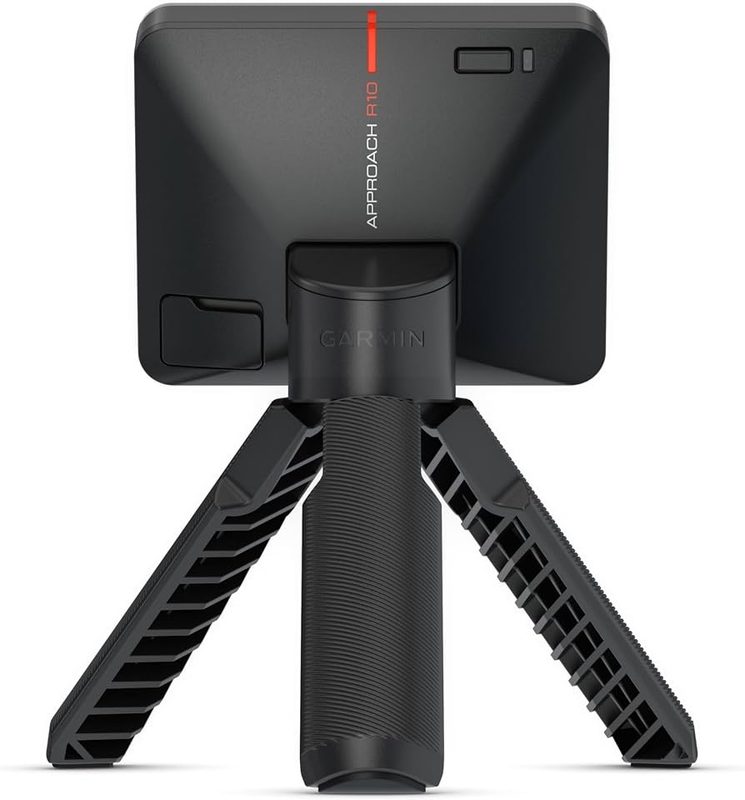
The Garmin Approach R10 is the launch monitor that made serious practice data affordable: a palm-sized Doppler radar unit that tracks more than a dozen club and ball metrics, records your swing on video, and turns a net or range session into a virtual round, all for roughly the price of a premium driver. MyGolfSpy rated it 9.3 out of 10 in its 2025 review and called it the best personal launch monitor under $500. The caveats are real but well understood, and for self-directed practice it remains the benchmark in its class.
Performance
Published testing consistently finds the R10 accurate where it matters most. MyGolfSpy's 2025 review highlighted a strong balance of accuracy and value, with ball speed accurate to plus-or-minus 1 mph, club head speed to plus-or-minus 3 mph, and launch angle and direction to plus-or-minus 1 degree each. Carry distance accuracy runs plus-or-minus 5 yards. Those tolerances are tight enough for genuine improvement work, and Garmin's own guidance says using balls with Radar Capture Technology (RCT) can improve spin accuracy dramatically and carry distance accuracy by up to half. The reviewers' consensus is that it will not match a $25,000 tour-grade unit on pinpoint accuracy, but nothing near its price does. For swing-speed work, gapping wedges and irons, and diagnosing launch and spin trends, the data is trustworthy.
Accuracy and Consistency
The R10 measures ball speed, launch angle, launch direction, spin rate, spin axis, and apex height directly from its Doppler radar, and derives metrics like smash factor and carry from those readings. Where published reviews flag inconsistency is indoors with longer clubs, where radar physics and limited ball flight can push readings off. The practical fix the reviewer community recommends is careful setup: place the unit 6 to 8 feet behind the ball on its tripod, aligned precisely at the target line, and keep the tee at least 8 feet from the net indoors. Follow the calibration routine and the numbers settle down considerably. It is a reminder that this is a radar device, not magic: garbage in, garbage out.
Feel and Setup
Garmin kept the physical product delightfully simple: a 3.5-by-2.8-inch black box weighing under 8 ounces with its tripod, rated IPX7 waterproof, running up to 10 hours on a charge. Setup means mounting the phone on the included bag-clip mount, opening the Garmin Golf app, and walking through alignment. Most reviewers describe setup as manageable with a learning curve rather than plug-and-play, and some find the app interface less intuitive than rivals. Once running, the experience is excellent: shot dispersion charts by club, training mode stat tracking, automatic swing video clips with the metrics overlaid, and weekly global tournaments. Home Tee Hero unlocks 42,000-plus virtual courses on a Garmin Golf membership, and E6 CONNECT compatibility opens up photorealistic third-party simulation for those who want a deeper sim experience.
Value
Value is the R10's entire reason for existing. Garmin lowered retail to $499.99 in 2026, and Amazon street prices frequently land lower, which buys Doppler radar accuracy that cost several thousand dollars not long ago. The asterisk is the subscription: Home Tee Hero virtual rounds and advanced features need a Garmin Golf membership at $99.99 a year or $9.99 a month after the included 30-day trial. Core training mode data and video features do not require it, but the virtual-course fun does. Even with the subscription, total cost of ownership stays well under any serious competitor, and Garmin's regular firmware updates have added meaningful metrics like club path and face angle over the years.
Who Should Buy It
The R10 fits practicing golfers who want honest swing data at home, indoors, or on the range without committing to a full simulator bay, players who like structured practice with dispersion charts and video, and golfers already in the Garmin ecosystem. It is less suited to players who demand tour-level spin accuracy, those who want a built-in screen without a phone, or anyone unwilling to manage an app and occasional calibration.
Verdict
Five years after launch, the Approach R10 is still the smart money in personal launch monitors. Accurate enough to train on, portable enough to live in your golf bag, and priced within reach of serious amateurs, it is the best value in golf technology. This is a research-based review.
Specifications
- Build and Battery
- 3.5 x 2.8 x 1.0 inches; about 7.8 ounces with tripod; internal rechargeable lithium-ion, up to 10 hours; IPX7 waterproof; Bluetooth connectivity
- Metrics
- Doppler radar tracks club head speed, ball speed, launch angle and direction, spin rate, spin axis, apex height, smash factor, club path, face angle, attack angle, swing tempo, carry and total distance
- Radar Accuracy
- Plus-or-minus 3 mph club head speed; plus-or-minus 1 mph ball speed; plus-or-minus 1 degree launch angle and direction; plus-or-minus 5 yards carry
- Setup
- Tripod-mounted 6 to 8 feet behind the ball, aligned to target line; pairs with compatible smartphone running the Garmin Golf app
- Simulator
- Home Tee Hero virtual rounds on 42,000-plus courses with Garmin Golf membership; E6 CONNECT compatible; auto swing-video recording with stat overlays
Strengths
- MyGolfSpy's 2025 review gave it 9.3 out of 10 and named it the best personal launch monitor under $500
- Tracks more than a dozen metrics including club head speed, ball speed, launch angle, spin, smash factor, club path, face angle, and attack angle
- Doppler radar accuracy of plus-or-minus 1 mph ball speed and plus-or-minus 1 degree launch angle is strong for the price
- Up to 10 hours of battery life with an IPX7 waterproof rating makes it genuinely portable for long range sessions
- Auto-records swing video clips with stat overlays so players can tie numbers directly to their mechanics
- Home Tee Hero plays 42,000-plus virtual courses, and it is also compatible with E6 CONNECT simulation software
Considerations
- There is no built-in display at all, so the unit is useless without a paired smartphone running the Garmin Golf app.
- Virtual rounds on 42,000-plus courses require a Garmin Golf membership at $99.99 per year after the 30-day trial, which adds real ongoing cost.
- Spin data accuracy lags behind premium camera-based monitors, and getting the best numbers requires RCT balls per Garmin's own guidance.
- Reviewer consensus notes inconsistent accuracy indoors with longer clubs, where readings can fall short of premium units.
- Alignment and calibration can be fiddly: the device must sit 6 to 8 feet behind the ball on its tripod or readings drift.